We focus on stopping problems before they start.
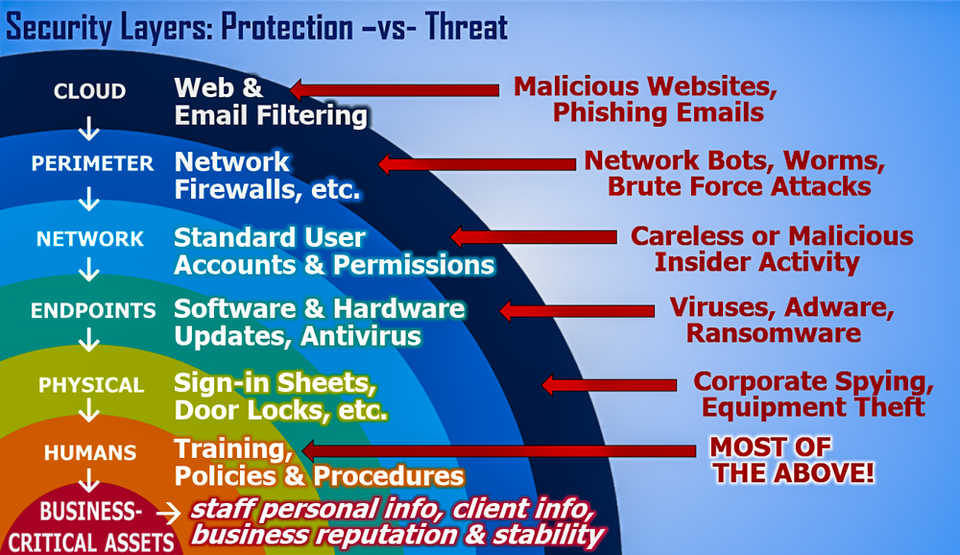
Most attacks begin in one of two places: email or the web. That’s why both are protected together. Email filtering blocks phishing attempts and malicious attachments. Web filtering acts as a second layer, stopping unsafe sites if a link is clicked.
From there, protection extends across the systems your business relies on every day, including servers, computers, desktops, laptops, and cloud accounts. Your network is also secured, including your internal office network, your internet connection, and your wireless (Wi-Fi) systems.
Access to your systems is controlled and monitored, with safeguards like multi-factor authentication to prevent unauthorized logins. Backups are protected as well, ensuring your data is recoverable if something goes wrong.
Security also plays a major role in regulatory and compliance requirements. Many businesses are expected to follow standards related to data privacy, cybersecurity, access control, and record protection. Depending on your industry, that may include frameworks and requirements such as HIPAA, PCI-DSS, FTC Safeguards Rule, CJIS, SOC 2, CMMC, or other industry-specific security expectations.
We help businesses align their systems, policies, access controls, monitoring, and security practices with those requirements so compliance becomes part of how the environment operates instead of a last-minute scramble before an audit or insurance review.
Each layer supports the next. If one control fails, another stands in the way. That is how real protection works.
Most attacks begin in one of two places: email or the web. That’s why both are protected together. Email filtering blocks phishing attempts and malicious attachments. Web filtering acts as a second layer, stopping unsafe sites if a link is clicked.
From there, protection extends across the systems your business relies on every day, including servers, computers, desktops, laptops, and cloud accounts. Your network is also secured, including your internal office network, your internet connection, and your wireless (Wi-Fi) systems.
Access to your systems is controlled and monitored, with safeguards like multi-factor authentication to prevent unauthorized logins. Backups are protected as well, ensuring your data is recoverable if something goes wrong.
Security also plays a major role in regulatory and compliance requirements. Many businesses are expected to follow standards related to data privacy, cybersecurity, access control, and record protection. Depending on your industry, that may include frameworks and requirements such as HIPAA, PCI-DSS, FTC Safeguards Rule, CJIS, SOC 2, CMMC, or other industry-specific security expectations.
We help businesses align their systems, policies, access controls, monitoring, and security practices with those requirements so compliance becomes part of how the environment operates instead of a last-minute scramble before an audit or insurance review.
Each layer supports the next. If one control fails, another stands in the way. That is how real protection works.